

Why Your Startup Could Fail Without Founder-Market Fit
From shallow market understanding to weak conviction, here’s what founders often get wrong

Why do some startups break through while others despite similar funding, talent, and ambition quietly stall?
The answer isn’t always the product.
It often comes down to something far more fundamental: how deeply the founder understands the market and the people they’re building for.
According to one research, nearly 35% of startups fail because founders don’t truly understand their customers or the market they’re entering. On the flip side, research from The Clueless Company shows that startups with strong Founder–Market Fit (FMF) are over 230% more likely to scale.
That contrast reveals a hard truth: Founder–Market Fit isn’t optional—it’s a hidden driver of success.
Before obsessing over product-market fit, growth hacks, or fundraising, founders should pause and ask:
Have I lived or worked in this market long enough to spot real, non-obvious problems?
Would I still pursue this idea if it wasn’t trendy or glamorous?
Why am I uniquely positioned to solve this problem right now?
Ideas can be copied. Products can pivot. Founder–Market Fit is the one advantage you can’t fake.
Key Facts at a Glance
35% of startups fail due to poor market understanding by founding teams
Founders with industry experience are 45% more likely to outperform peers (Stanford research)
Startups with strong FMF are up to 50% more likely to raise funding
Why Top VCs Bet on Founder–Market Fit Before Product–Market Fit
Founder–Market Fit exists when a founder’s background, experience, network, and personal motivation uniquely position them to solve a specific problem in a specific market.
In simple terms:
FMF answers “Why you?”
PMF answers “Why this product?”
This is why top VCs often back founders before the product is fully formed. A founder who deeply understands the industry doesn’t just pitch better—they see around corners.
Stanford research shows that founders with prior industry experience outperform others by 45%. That advantage shows up repeatedly in real-world success stories.
Take Mark Zuckerberg. Facebook didn’t emerge from trend analysis—it came from living inside a closed social ecosystem (Harvard) and understanding its dynamics better than anyone else.
Founder–Market Fit isn’t always innate. Often, it’s built through obsession, immersion, and lived experience.
Learning by Doing: When Founder–Market Fit Is Built, Not Born
Case 1: Airbnb — Brian Chesky & Joe Gebbia
Airbnb didn’t start with hospitality experts. It started with two broke designers trying to pay rent.
Brian Chesky and Joe Gebbia rented out air mattresses in their San Francisco apartment. Instead of theorizing about the market, they lived the problem, spoke directly with guests and hosts, and iterated based on firsthand feedback.
The result:
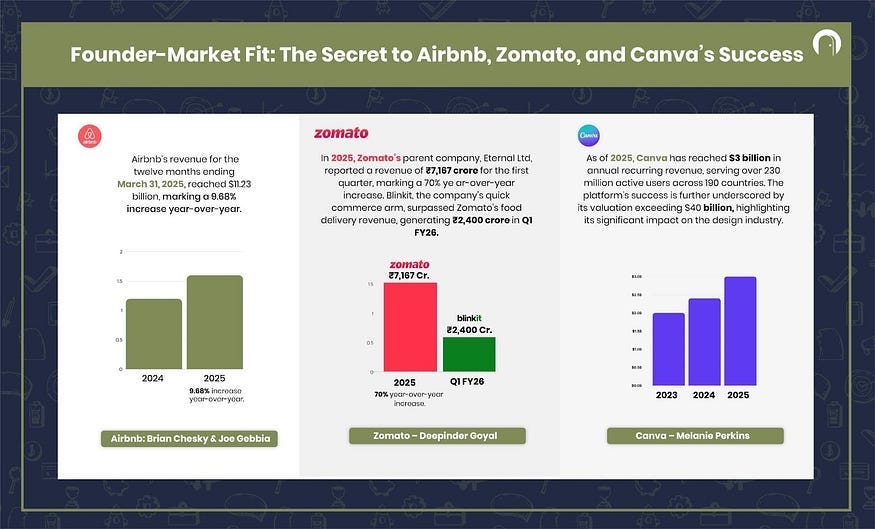
Airbnb generated $11.23 billion in revenue in the twelve months ending March 31, 2025—a 9.68% year-over-year increase.
Lesson: Airbnb succeeded because the founders deeply understood both sides of the marketplace. FMF was built by living the problem, not studying it from afar.
Case 2: Zomato — Deepinder Goyal
Zomato began as a simple solution to a personal frustration. Deepinder Goyal noticed how difficult it was to access restaurant menus—and started uploading them manually.
Rather than rushing to scale, he immersed himself in the food ecosystem, speaking directly with restaurant owners and customers. That proximity shaped Zomato’s evolution from a menu platform into a full-stack food and quick-commerce company.
The result:
In Q1 2025, Zomato’s parent company reported ₹7,167 crore in revenue, up 70% year-over-year. Blinkit alone generated ₹2,400 crore, surpassing Zomato’s core food delivery business.
Lesson: FMF came from deep market immersion—not from tech alone.
Case 3: Canva — Melanie Perkins
Canva was born out of frustration. Melanie Perkins saw firsthand how difficult traditional design tools were for students.
Instead of guessing, she spoke relentlessly with users—students, teachers, and professionals—learning what they struggled with and what they actually needed.
The result:
By 2025, Canva reached $3 billion in annual recurring revenue, with 230+ million active users across 190 countries and a valuation exceeding $40 billion.
Lesson: Canva wasn’t built for the market—it was built from within it.
Founder–Market Fit ≠ Loving Your Product
One of the most common—and dangerous—mistakes founders make is confusing Founder–Product Fit with Founder–Market Fit.
Loving what you’re building doesn’t mean the market cares.
FMF is about understanding:
Customer behavior
Industry incentives
Real-world constraints
Not just your vision.
Warning Signs of “Fake” Founder–Market Fit
High enthusiasm, low traction: Passion without user pull is a red flag
Building in isolation: Little or no feedback from real customers
Ignoring behavior in favor of vision: Romanticizing ideas while dismissing how users actually act
True FMF leads to the right product—not just the product you want to build.
When Founder–Market Fit Meets Product–Market Fit
When FMF and PMF align, startups don’t just grow—they dominate.
Case 1: Slack — Stewart Butterfield
Slack began as a failed gaming startup. But Butterfield recognized that the internal communication tool his team built was more valuable than the game itself.
His deep understanding of collaboration and team dynamics led to a successful pivot.
The result:
By 2025, Slack reached 47.2 million daily active users, 79 million monthly active users, and $6.98 billion in annual revenue.
Why it worked:
FMF enabled the right pivot; PMF sustained growth.
Case 2: Tesla — Elon Musk
Elon Musk’s FMF comes from years spent at the intersection of engineering, energy, and long-term systems thinking.
Tesla didn’t just follow the EV trend—it helped create it.
The result:
In Q2 2025, Tesla delivered 384,122 vehicles and deployed 9.6 GWh of energy storage, with plans to grow storage deployments by 50%.
Why it worked:
A founder whose skills, mission, and market were tightly aligned.
Final Thoughts
Founder–Market Fit is the advantage most founders overlook—and the one investors quietly prioritize.
It’s not about passion for the product.
It’s about understanding the problem so deeply that you’re the obvious person to solve it.
FMF can’t be faked. It’s earned through experience, obsession, and real market exposure.
Before you pitch, build, or raise, ask yourself one question:
Why are we the best to solve this problem?
If funding is your next hurdle, Exitfund helps founders turn real Founder–Market Fit into investor-ready stories.
Founder–market fit is such an underrated concept! This piece nails how it often matters before product–market fit. As someone who deals with the "people" side of startups I always encourage founders to answer this question.
What really resonated is the idea that FMF is “built, not born.” The Airbnb, Zomato, and Canva examples show that you don’t need decades in an industry, but you do need to live the problem and stay uncomfortably close to customers....not just your "vision."
I also like the distinction between loving your product vs. actually understanding the market’s behavior and constraints: “high enthusiasm, low traction” is a painfully accurate warning sign so many founders ignore.
Big takeaway for me: if you can’t clearly answer “Why you, for this market, right now?”, it’s probably too early to obsess over growth hacks or fundraising!