

Why Refusing To Pivot Is The Fastest Way To Kill A Startup
Lessons from startups that stopped obsessing over vision and started pivoting

When you think about startup success, what comes to mind?
Vision? Hustle? That magical moment that changes the world?
Here’s the reality nobody likes to say out loud: most first ideas are wrong. And if you refuse to pivot? That’s the fastest way to kill your startup.
Some of the world’s biggest companies exist because their first idea failed. They didn’t win by getting it right the first time; they won by paying attention, adapting, and pivoting when reality demanded it.
According to a WinSavvy study, 92% of startups pivot at least once before finding true product–market fit. Yet pivoting still carries a stigma that many founders see as admitting failure. History says otherwise. YouTube, Slack, Instagram, Netflix, and PayPal all prove that pivoting isn’t a sign of weakness; it’s a superpower.
Quick Hits: What Every Founder Should Know About Pivots
Pivoting ≠ failure. It = smart survival.
Users reveal the real market before you do. Watch them.
Early pivots save time, money, and sometimes the whole company.
Complexity slows adoption; simplicity accelerates growth.
Sometimes the side project or the “small feature” is the goldmine.
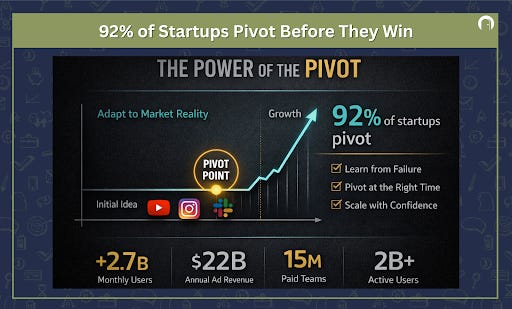
Let’s explore 6 of the top companies that didn’t get it right the first time, but won because they pivoted. Each story shows how paying attention to users, simplifying, and adapting can turn a failing idea into a market-defining business.
1. YouTube—From Failed Dating Site to Internet Giant
Original idea: Three ex-PayPal employees launched a video dating platform in 2005. The idea? People could upload videos to make online dating more authentic.
Reality check: The platform flopped, but there was a twist. Users weren’t uploading dating videos; they were posting random clips: cats, skateboarding tricks, friends goofing around.
Pivot: The founders noticed this unexpected behavior and opened the platform to all videos, not just dating.
Result: Growth exploded. By 2006, Sequoia Capital invested to help scale, and later that year, Google acquired YouTube for $1.65B. Today, it has over 2.7B monthly active users.
Lesson: Don’t cling to your assumptions. Watch how people actually use your product—sometimes the “wrong” idea points you to the right opportunity.
2. Slack—When a Side Project Becomes the Main Event
Original idea: Tiny Speck was building a multiplayer online game.
Reality check: Despite years of development, the game didn’t gain traction. But internally, the team noticed that the messaging and collaboration tool they had built for themselves was incredibly useful.
Pivot: Kill the game. Focus fully on the chat tool.
Result: Slack launched in 2013 and quickly became the go-to workplace communication platform. Millions of daily users later, Salesforce acquired it for $27.7B.
Lesson: Sometimes the feature that wasn’t supposed to matter ends up being the whole business. Pay attention to how people are using your product—it may be more revealing than your original plan.
3. Instagram—Strip It Down to What People Love
Original idea: Burbn was a feature-heavy check-in app inspired by Foursquare.
Reality check: Users hated the clutter but loved sharing photos.
Pivot: Strip away all other features, leaving just photo-sharing, filters, and social connectivity.
Result: Instagram launched in 2010, grew virally, and today boasts over 3B monthly users.
Lesson: Complexity slows adoption. Focusing on what users actually love can be a game-changer.
4. Netflix—Profits Are Nice, But Vision Wins
Original idea: DVD rentals by mail. Netflix competed directly with Blockbuster.
Reality check: Broadband internet and streaming technology were emerging, and leadership foresaw that consumer habits were shifting toward instant access.
Pivot: Move into streaming, then create original content to differentiate from competitors.
Result: Netflix now has over 301M subscribers globally and reshaped how the world consumes entertainment.
Lesson: Protecting a profitable model for too long can be riskier than disrupting it yourself.
5. PayPal—Follow the Users
Original idea: Cryptography-focused payment system for PalmPilot devices.
Reality check: Adoption was slow. But users were sending money via email, particularly for eBay transactions.
Pivot: Focus on this unexpected use case.
Result: PayPal became the default online payments platform and now processes $1.68 trillion annually.
Lesson: Users often reveal the real market before you do.
6. Twitter — When a Pivot Saves the Company
Original idea: Podcast platform called Odeo.
Reality check: Apple entered the podcast market, instantly making Odeo irrelevant.
Pivot: Experiment internally with a short status-update tool. This side project evolved into Twitter.
Result: Today, Twitter has 600M monthly active users and reshaped real-time communication globally.
Lesson: Not every breakthrough starts as a core strategy.
The Founder’s Pivot Playbook
Stop defending assumptions. Start observing reality.
Keep what works. Drop what doesn’t.
Simplify relentlessly. Complexity kills growth.
Watch small signals. Tiny user behaviors often point to product–market fit.
Pivot early. Waiting too long kills momentum.
Final Thought
Startups don’t fail because the first idea is bad. They fail because founders refuse to pivot.
The real question isn’t: Am I right?
It’s: Am I paying attention?
History doesn’t reward the stubborn. It rewards the adaptable, the observant, the brave.
So: watch, listen, pivot. Your future self and your users will thank you.
And if funding is part of the puzzle, Exitfund can help you get the right support at the right time, so your pivot doesn’t just survive—it thrives.