

Why India Targeted Telegram Over The NEET Leak?
When millions lose access to a platform because of the actions of a few, where should responsibility really lie?

In June 2026, India temporarily blocked Telegram after authorities linked the platform to the circulation of leaked NEET examination materials.
The examination affects millions of aspiring medical students across India every year, making it one of the country’s most consequential entrance tests.
When leaked exam materials allegedly began circulating on Telegram, authorities responded by temporarily blocking a platform used by an estimated 150 million+ users in India.
This move affected one of Telegram’s largest user bases globally and quickly escalated into a legal battle. Telegram challenged the government’s decision, arguing that a blanket shutdown was disproportionate.
However, the court rejected the appeal, allowing the temporary restriction to remain in place.
That decision turned an exam scandal into a much bigger conversation.
Did blocking Telegram actually stop the problem?
Why were millions of users affected by the actions of a few?
Should platforms be blamed for what happens on them?
And if governments can block one app today, what could they block tomorrow?
The Telegram controversy isn’t just about an exam leak. It’s about how governments, technology companies, and citizens navigate accountability in an era where a single message can reach millions, and where the consequences of stopping that message can be just as significant as the message itself.
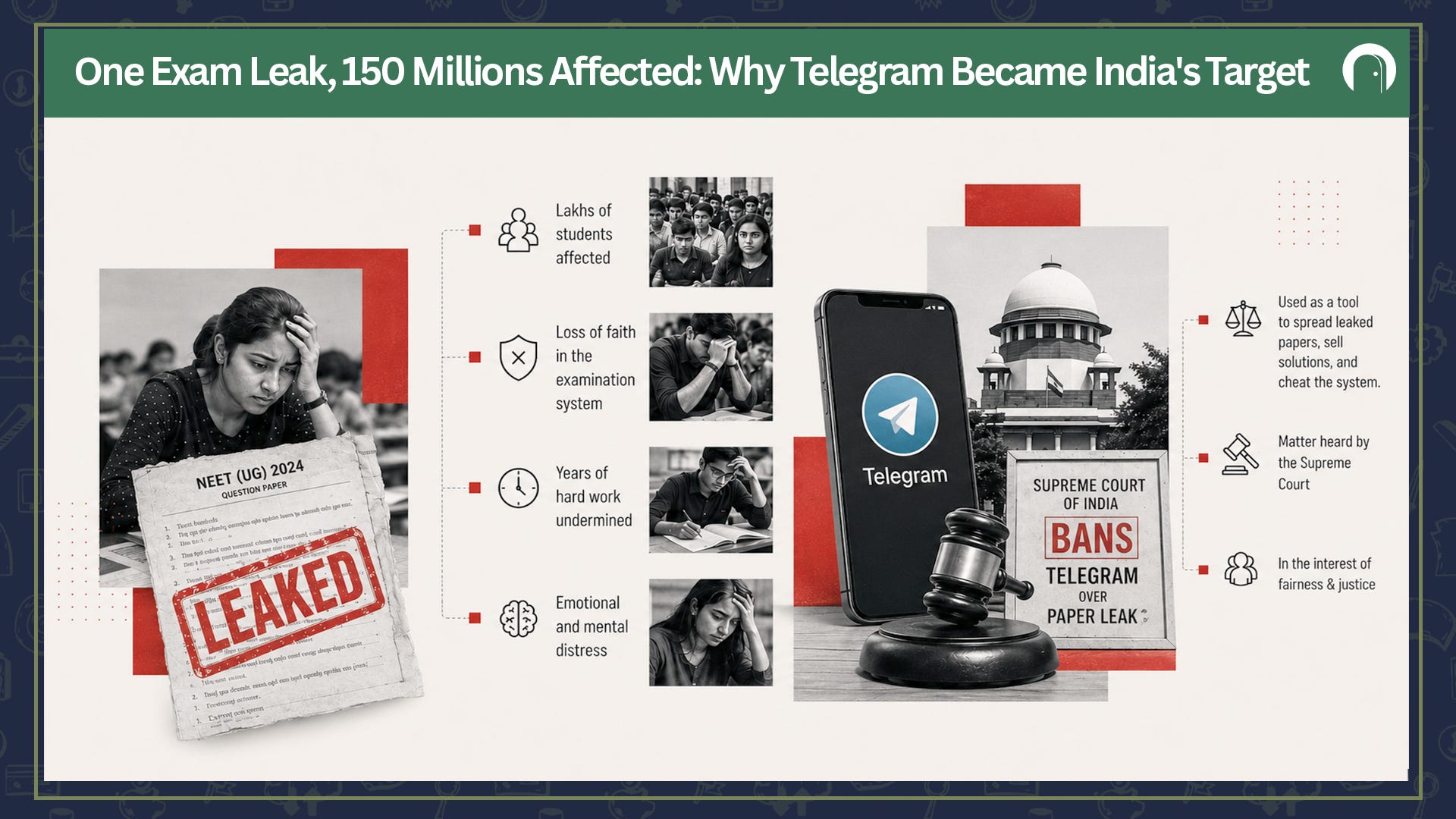
Why the NEET Exam Matters So Much
For readers outside India, it’s difficult to overstate the significance of NEET.
The National Eligibility cum Entrance Test determines admission into medical colleges across the country. Every year, millions of students spend years preparing for a single exam that can shape their future careers.
The pressure is immense.
Families invest significant financial resources into coaching, students sacrifice social lives, and competition is fierce. When allegations emerge that exam papers were leaked or sold, public outrage follows naturally.
The issue isn’t merely academic misconduct.
It strikes at the credibility of one of the country’s most important merit-based systems.
If students believe the system can be manipulated, trust collapses.
And once trust collapses, governments face enormous pressure to act decisively.
Why Telegram Became the Focus?
Telegram has long occupied a unique position in the digital ecosystem.
Unlike traditional social networks, Telegram combines:
Massive group capabilities
Channel broadcasting
Rapid content distribution
Strong privacy features
Large-scale community management
These characteristics make it useful for educators, businesses, journalists, activists, and communities.
They also make it attractive to bad actors.
According to authorities, leaked examination materials circulated rapidly through Telegram channels and groups, making the platform a focal point of the investigation.
From the government’s perspective, the logic likely looked straightforward:
Exam materials were spreading through Telegram.
The spread threatened exam integrity.
Immediate intervention was necessary.
Restricting Telegram could slow dissemination.
Viewed through this lens, blocking the platform becomes an emergency containment strategy.
But critics argue that containment is not the same thing as solving the problem.
The Platform vs. Criminal Debate
This controversy reflects a broader global struggle.
Whenever illegal activity occurs online, policymakers face a recurring dilemma:
Option A: Pursue Individual Offenders
Advantages:
Targets actual perpetrators
Preserves legitimate platform use
Avoids collateral damage
Challenges:
Time-consuming investigations
Cross-border legal complications
Anonymous actors
Encrypted communications
Option B: Restrict the Platform
Advantages:
Immediate impact
Visible government action
Potentially disrupts distribution networks
Challenges:
Affects innocent users
Raises censorship concerns
May not stop future incidents
Criminals often migrate elsewhere
This tension has appeared repeatedly across the world.
Governments often choose platform-level intervention because it is visible, immediate, and politically understandable.
Investigating sophisticated criminal networks is much harder.
Blocking a service can happen overnight.
The Optics Problem
Politics is often driven by perception as much as outcomes.
Imagine a government facing public anger after an exam leak.
Parents demand accountability.
Students demand fairness.
Media coverage intensifies.
The government needs to demonstrate action.
A platform ban creates a powerful headline:
“Authorities take decisive action.”
A multi-month criminal investigation does not generate the same immediate visibility.
This creates what policy experts sometimes call the “optics advantage.”
The public sees movement.
Whether the underlying problem is solved remains a separate question.
Did Blocking Telegram Actually Solve Anything?
This is where the debate becomes more nuanced.
A platform shutdown can reduce immediate distribution.
But long-term effectiveness is less clear.
History suggests that when one communication channel becomes unavailable, determined actors often migrate elsewhere.
Potential alternatives include:
Private messaging apps
Encrypted platforms
Cloud storage links
Forums
Social media groups
Dark web communities
Technology rarely eliminates demand.
It merely changes where activity occurs.
This is why cybersecurity experts often emphasize that sustainable solutions require targeting networks, incentives, and organizers rather than only distribution tools.
The challenge is that such solutions require time.
Governments under public pressure rarely have the luxury of time.
The Free Speech and Privacy Concerns
Critics of the Telegram block argue that millions of legitimate users were affected despite having no connection to the exam leak.
These users relied on Telegram for:
Business communication
Education
Community groups
News distribution
Professional networking
For them, the restriction felt less like a targeted enforcement action and more like collective punishment.
This concern extends beyond Telegram.
If governments normalize platform-wide restrictions whenever illegal activity occurs, critics worry the threshold for future interventions could become increasingly low.
The question becomes:
Where should governments draw the line?
Every platform hosts some level of harmful activity.
No platform is entirely free from misuse.
If misuse alone justifies shutdowns, nearly every major digital platform could eventually face similar scrutiny.
The Business Implications for Technology Platforms
The case sends a powerful message to technology companies.
Historically, many platforms viewed themselves as neutral intermediaries.
That position is becoming harder to maintain.
Governments worldwide increasingly expect platforms to:
Detect harmful activity
Remove illegal content
Cooperate with investigations
Strengthen moderation systems
Respond rapidly to crises
The era of “we are just the platform” is fading.
Whether companies agree or not, regulators increasingly expect active participation in enforcement efforts.
This trend affects not only messaging apps but also:
Social networks
Cloud providers
AI companies
Content-sharing platforms
Online marketplaces
The regulatory burden is expanding across the digital economy.
Key Lessons for Policymakers
1. Speed and Effectiveness Are Not the Same Thing
Rapid intervention can calm public outrage, but long-term solutions require addressing root causes.
2. Platform Bans Carry Collateral Damage
Millions of legitimate users may be affected by actions aimed at a relatively small group of offenders.
3. Trust Is Harder to Restore Than to Protect
Once confidence in examination systems erodes, rebuilding credibility becomes extraordinarily difficult.
4. Criminal Networks Adapt Quickly
Removing one channel rarely eliminates illicit activity entirely.
5. Transparency Matters
Governments that clearly explain their rationale often maintain greater public trust during controversial interventions.
Final Thoughts
The controversy surrounding Telegram and the NEET leak is not simply a story about a messaging app.
It is a case study in how governments respond when public trust is threatened in the digital age.
Supporters of the block see a necessary intervention to protect examination integrity.
Critics see an overreach that punishes millions for the actions of a few.
Both perspectives highlight a difficult reality: modern societies increasingly depend on digital platforms, yet those same platforms can be exploited in ways that create real-world harm.
The uncomfortable truth is that there may not be a perfect answer.
But the questions raised by this episode will continue to shape debates about privacy, accountability, free expression, and platform responsibility long after the Telegram block is lifted.
And that is why this story matters far beyond a single exam leak.