

Meta Robotics Strategy Explained: Assured Robot Intelligence and the Future of Humanoid AI
Behind the quiet deal is a $145B bet on robotic intelligence and a shift from software AI to real-world automation.

The most important AI move this month didn’t come with a flashy product launch or a viral demo.
There was no new chatbot. No model benchmark. No keynote.
Instead, Meta Platforms quietly acquired Assured Robot Intelligence, a small, highly specialized startup working on AI systems for robots.
On its own, the deal looks minor. The terms weren’t even disclosed.
But zoom out, and the context changes everything.
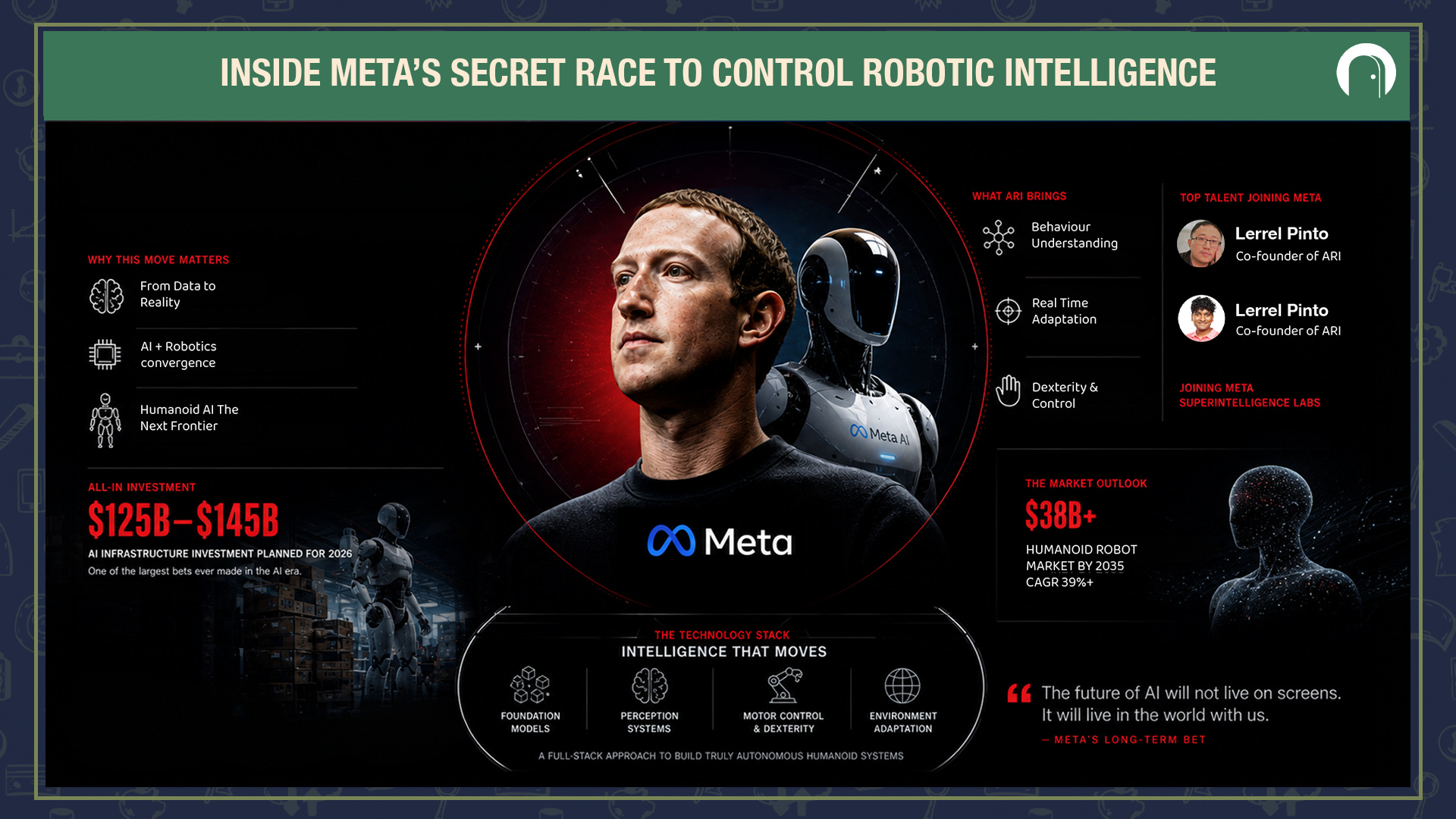
Meta has simultaneously raised its projected capital expenditure to $125–$145 billion for 2026, one of the largest AI investment cycles in tech history. This spending is aimed at building out data centers, compute infrastructure, and next-generation AI systems.
Put those two signals together, and a clearer picture emerges:
Meta isn’t just investing in AI models.
It’s investing in AI that can operate in the real world.
What Meta actually bought
Despite the headlines, Assured Robot Intelligence isn’t a robotics hardware company.
It’s something more strategic.
Founded by researchers including Xiaolong Wang and Lerrel Pinto, the company focuses on building AI models that allow robots to understand and interact with their environment.
That includes:
Learning from real-world data
Adapting to unpredictable scenarios
Interpreting human behavior
Manipulating objects without rigid programming
In other words, ARI is building the “brain layer” for robots.
And that distinction matters.
Robotics hardware is becoming commoditized.
Intelligence—the ability to operate autonomously—is the real bottleneck.
By acquiring ARI (a team of roughly 20 people), Meta isn’t buying a product.
It’s absorbing capability.
From Metaverse to machines
For years, Meta’s long-term vision was tied to the metaverse, immersive digital worlds, virtual interaction, and augmented reality.
That narrative is now shifting.
Internally, Meta has been reorganizing around AI, forming new initiatives focused on superintelligence and advanced systems. The company is redirecting capital, talent, and strategy toward building foundational AI infrastructure.
The ARI acquisition fits squarely into that transition.
It signals a move:
From virtual environments → physical environments
From digital interaction → real-world execution
This isn’t an abandonment of past bets. It’s an evolution of them.
If the metaverse was about simulating reality,
robotic AI is about acting within it.
The new AI race: intelligence + embodiment
For the past two years, the AI race has been defined by one question:
Who can build the most powerful model?
Now, a second question is emerging:
Who can deploy that intelligence in the physical world?
Meta is not alone in this shift:
NVIDIA is building simulation platforms to train robots at scale
Amazon continues expanding robotics across logistics and fulfillment
Google is investing in embodied AI research
OpenAI is moving toward agents that can take real-world actions
What used to be a software competition is quickly becoming a race to build intelligent systems that can perceive, decide, and act.
Why this matters more than another AI model
Generative AI changed how work gets done.
Robotic AI could change who—or what—does the work.
That’s the real implication behind Meta’s move.
ARI’s focus on human behavior modeling and adaptive learning suggests a future where machines are not just tools, but operators:
In warehouses
In retail environments
In logistics networks
Eventually, in homes and care settings
This isn’t speculative anymore. It’s an active area of investment.
And when paired with Meta’s scale, its infrastructure, data, and capital, the timeline compresses.
The uncomfortable layer: risk, cost, and control
Not everyone is convinced.
Meta’s aggressive spending has already raised concerns among investors. Following its increased AI capex projections, the company’s stock saw a noticeable decline—reflecting skepticism around both timeline and returns.
There are real risks here:
Unclear monetization of robotics in the near term
Massive infrastructure costs with long payback cycles
Execution complexity at the intersection of AI and hardware
And then there’s the broader concern:
If a handful of companies control both intelligence (AI models) and execution (robots), they don’t just shape technology—they shape labor itself.
That’s a level of influence far beyond previous tech cycles.
What happens next
In the short term, expect incremental progress:
More capable robots in controlled environments
Expanded use in logistics and industrial settings
In the medium term:
Early consumer-facing applications
Integration of AI agents with physical systems
Long term:
General-purpose robotic systems
Autonomous machines capable of replacing entire categories of work
The transition won’t be instant. But it will be directional—and difficult to reverse.
What this means for founders and AI builders
Meta’s move into robotic intelligence isn’t just a Big Tech story. It’s a signal about where the next wave of opportunity—and competition—is heading.
For founders and builders, there are a few clear lessons emerging.
1. The real opportunity is shifting beyond software
For the last decade, the biggest wins in tech came from software: apps, SaaS platforms, marketplaces.
That layer is now crowded.
What Meta’s acquisition of Assured Robot Intelligence makes clear is that the next frontier is AI applied to the physical world.
That doesn’t mean every startup needs to build robots. But it does mean thinking in terms of:
AI that interacts with real environments
Systems that connect software to physical outcomes
Automation beyond screens
The biggest opportunities will sit at the intersection of AI + real-world execution.
2. Intelligence is becoming the most valuable layer
Hardware will improve. Sensors will get cheaper. Robotics platforms will become more accessible.
But intelligence—the ability to perceive, decide, and adapt—is still the hardest problem.
That’s exactly why Meta Platforms acquired a team like ARI.
For builders, this suggests:
Focus on models, decision systems, and behavior understanding
Build capabilities that can plug into multiple platforms
Think in terms of systems, not features
The long-term winners won’t just build tools.
They’ll build intelligence layers others depend on.
3. Small teams can create massive leverage
ARI reportedly had around 20 people.
Yet it became strategically valuable enough for Meta to acquire.
This reinforces a pattern already visible in AI:
Small, highly specialized teams
Deep technical focus
Fast iteration cycles
For founders, this is an advantage.
You don’t need scale to be relevant.
You need precision and speed in the right problem space.
4. Talent is becoming more valuable than products
This deal wasn’t about revenue. It wasn’t about distribution.
It was about capability.
Meta is effectively buying:
Research talent
Technical expertise
Future potential
For builders, this changes how you think about value:
Building something cutting-edge can be enough
Early-stage innovation is a defensible asset
Positioning matters as much as traction
In AI, who you are building with is often as important as what you’re building.
5. The stack is expanding—and so are the opportunities
The AI stack is no longer just:
Models
APIs
Applications
It’s expanding into:
Robotics
Simulation environments
Real-world data systems
Edge intelligence
Every layer in this stack is still early.
That creates opportunities for:
Infrastructure startups
Tooling platforms
Vertical-specific solutions
The biggest companies will own the full stack.
But there is room to build critical layers within it.
6. Speed is now a strategic advantage
ARI was founded in 2025 and acquired in 2026.
That timeline would have been unthinkable a decade ago.
In AI, cycles are compressing:
Research → product → acquisition
Idea → validation → scale
For founders, this means:
Launch earlier
Iterate faster
Don’t wait for perfection
The market is rewarding momentum over completeness.
The real takeaway
It’s easy to see this as just another acquisition in a crowded AI landscape.
It’s not.
It’s a signal.
A signal that the next phase of AI won’t be defined by what happens on a screen—but by what happens in the real world.
For years, the dominant narrative has been that AI will augment human work.
But moves like this suggest a different possibility:
That the end goal isn’t just to assist human labor,
but to replicate it.
And if that’s the case, the most important question isn’t whether this future arrives.
It’s who builds it—and who controls it when it does.