

Global Internet Chaos: Cloudflare, AWS and Microsoft Fail Together
Three outages in a month reveal how dependent the world is on fragile cloud infrastructure

Yesterday was one of those days where the internet just… fell apart for millions of people.
Not fully offline, but definitely not okay.
Apps weren’t loading.
Websites kept crashing.
ChatGPT stopped replying.
X wouldn’t refresh.
People everywhere were wondering if their Wi-Fi died or if something much bigger was happening.
Turns out, it was something bigger.
Cloudflare, one of the companies that quietly keeps a huge part of the internet running, hit a hidden software bug.
Nothing dramatic, nothing malicious.
Just one tiny issue buried deep in their system that suddenly caused everything to spiral.
A simple routine update
→ triggered that bug
→ which caused crashes
→ which then spread across tons of websites and apps.
That’s why X, Perplexity, ChatGPT, Claude, and so many others started glitching or going down completely.
Cloudflare’s CTO quickly clarified:
No attack. No hacking.
Just a software bug doing what software bugs do—showing up at the worst possible time.
And it reminded everyone of something we forget:
The internet feels huge, but it rests on a few important companies.
When one of them has a bad day, the whole world feels it.
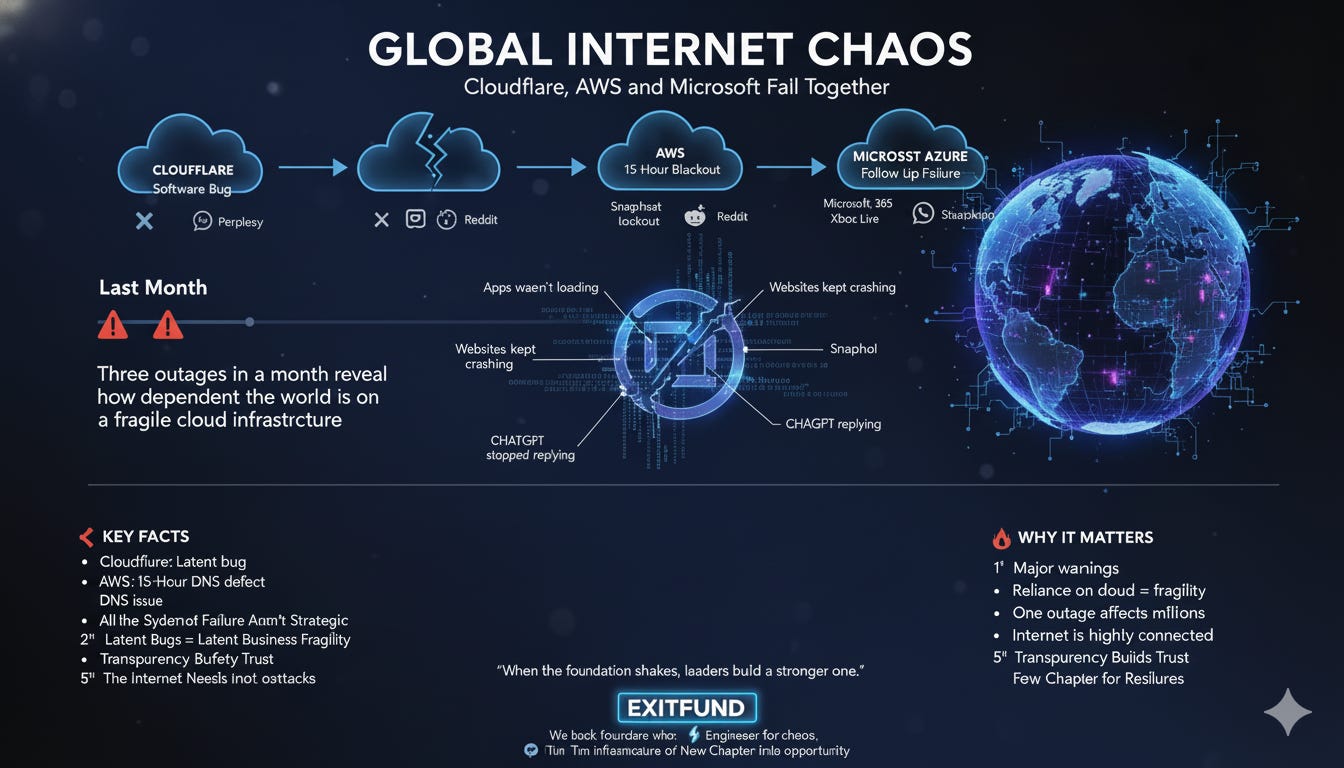
🔑 Key Facts
Cloudflare outage caused widespread failures across X, ChatGPT, Perplexity, Claude, and more.
Root cause: a latent bug inside Cloudflare’s bot-mitigation systems.
AWS outage took down huge portions of the internet for up to 15 hours.
Microsoft Azure outage hit global services from productivity tools to airlines.
All three incidents were not attacks, but system defects.
And this was just one of several big outages this year.
We’ve seen two major outages in the last month alone, and both came from internet giants.
AWS: The 15-Hour Blackout
Not long before the Cloudflare mess, AWS had its own major outage, and it lasted up to 15 hours for some people.
Huge platforms went down or slowed to a crawl:
Snapchat, Reddit, WhatsApp, Signal, Roblox, Fortnite, Xbox, PlayStation, and even Amazon’s own services.
And the cause?
A hidden defect in AWS’s automated DNS system—basically, the tool that tells the internet where everything lives.
One tiny bug in that system
→ confused the internet
→ and created hours of global disruption.
It showed how one quiet mistake inside a huge cloud provider can affect millions of people in minutes.
Microsoft Azure: The Follow-Up Failure
Then, just days later, Microsoft Azure ran into similar trouble.
This time, Microsoft 365, Xbox Live, Minecraft, Costco’s systems, Starbucks, airlines, and airports all felt the impact.
The cause?
DNS again.
The same core part of the internet that broke things at AWS also created issues here.
It was another reminder that the internet doesn’t fail in one place—when one big provider hits trouble, the effects spread fast.
The pattern is unmistakable:
The internet is only as stable as the systems it quietly depends on.
🔥 Why It Matters
These outages were not small glitches. There were major warnings for everyone who builds on the internet.
We rely on cloud providers for speed and stability, but that stability can be compromised unexpectedly.
One outage can affect millions of people at the same time. Apps, airlines, payments, messages and games can all stop together.
The internet is highly connected. This is powerful, but it also means one problem can spread far and wide.
For founders and builders, this is a reminder to prepare for failures, not just hope they do not happen. Redundancy and backups are essential.
👑 Founder Parallels — What Leaders Do When Infrastructure Breaks
When critical systems fail, great founders don’t panic — they pivot, adapt, and redesign the foundation.
The recent AWS, Cloudflare, and Azure outages reveal the same lesson top founders learned long ago:
Instability is not a warning to retreat. It’s a signal to reinvent.
Satya Nadella — Microsoft
→ Faced a world moving faster than Microsoft’s old model.
→ Bet big on cloud, resilience, and distributed systems.
→ Turned fragility into a trillion-dollar transformation.
Drew Houston — Dropbox
→ Recognized the danger of relying on a single infrastructure stack.
→ Built multi-cloud thinking into Dropbox’s DNA.
→ Made resilience a competitive advantage, not just a safeguard.
Brian Chesky — Airbnb
→ COVID crushed travel overnight.
→ He rebuilt Airbnb around flexibility, local experiences, and a redesigned cost structure.
→ Proved that when your core system fails, your strategy must evolve.
The thread connecting them?
They didn’t treat disruption as a threat to endure; they treated it as information to act on.
In a world where even Cloudflare, AWS, and Azure can fall, founders must think the same way:
When the foundation shakes, leaders build a stronger one.
🧭 Lessons for Builders When Infrastructure Shakes
1️⃣ Single Points of Failure Aren’t Technical — They’re Strategic
If one provider going down can kill your product, that’s not a bug.
That’s a business risk.
2️⃣ Latent Bugs = Latent Business Fragility
A rare edge case in someone else’s system can become your outage.
Founders must architect resilience ahead of scale.
3️⃣ Cloud Isn’t a Safety Net — It’s a Shared Dependency
When AWS or Cloudflare breaks, everyone pays the price.
Diversification is no longer optional.
4️⃣ Transparency Builds Trust
Cloudflare’s rapid communication softened the blow.
Outages happen — leadership is how you respond.
5️⃣ The Internet Needs a New Chapter of Resilience
The world is moving toward multi-cloud, edge computing, and redundancy-first design.
Builders who embrace this will define the next decade of uptime.
🔮 Closing Thoughts
Three outages. Three giants. One message:
We’ve outgrown the illusion of unbreakable infrastructure.
These failures aren’t just technical events — they’re inflection points for the entire ecosystem.
The founders who will win the next era aren’t the ones who pray for stability.
They’re the ones who design for volatility.
At Exitfund, we back founders who:
⚡ Engineer for chaos.
🧠 Anticipate fragility.
💬 Turn infrastructure disruption into opportunity.
Because the future won’t be shaped by the companies waiting for things to be stable.
But by the ones building for a world where stability can never be assumed.