

AI Will Take Over Software Engineering—And That’s Just The Beginning
Dario Amodei predicts human-level AI on most knowledge work within three years. Here’s what founders, CTOs, and investors need to know

Dario Amodei said AI could reach human-level performance on most knowledge tasks within 3 years.
And it’s scary.
Because this is coming from the CEO of Anthropic, the company behind Claude. And if you’ve tried Claude Opus 4.6, you can already feel how close we are.
Not a decade.
Not five years.
Three.
This is one of the first times a frontier AI leader has attached a concrete near-term timeline to AGI-level capability, and he is not talking about science fiction.
He is talking about systems that can perform most verifiable intellectual work: writing production software, solving complex math problems, analyzing data, at or above the human level.
What Amodei Means by “Verifiable Work”
Verifiable work has measurable outcomes. Code either runs or it doesn’t. A math problem either has a correct answer or it doesn’t. These clear feedback signals allow AI models to learn and improve at a massive scale, accelerating progress in ways humans can track.
Non-verifiable tasks like writing novels, inventing drugs, or designing entirely new systems are harder. But software, math, and data are low-hanging fruit for AI.
In a recent interview with Dwarkesh Patel, Amodei said he is “very confident” AI will handle all software engineering end-to-end within 1–2 years. He even quipped, “There’s no way we will not be there in ten years” for coding.
Amodei’s view differs from classic AGI definitions that emphasize human-like consciousness or general learning. He explicitly rejects that baggage. Instead, he focuses on functional competence: can AI perform tasks at or above the expert level?
Why This Should Keep Founders and CTOs Awake?
That raises questions that keep founders, CTOs, and investors up at night:
If AI can handle software engineering end-to-end, what happens to engineering teams and traditional hiring models?
How will startups compete when execution and expertise can be replicated instantly by machines?
What does it mean for an economy that depends on trillions of dollars of human software labor?
Let’s find out why software might be just the beginning of a much bigger shift in knowledge work.
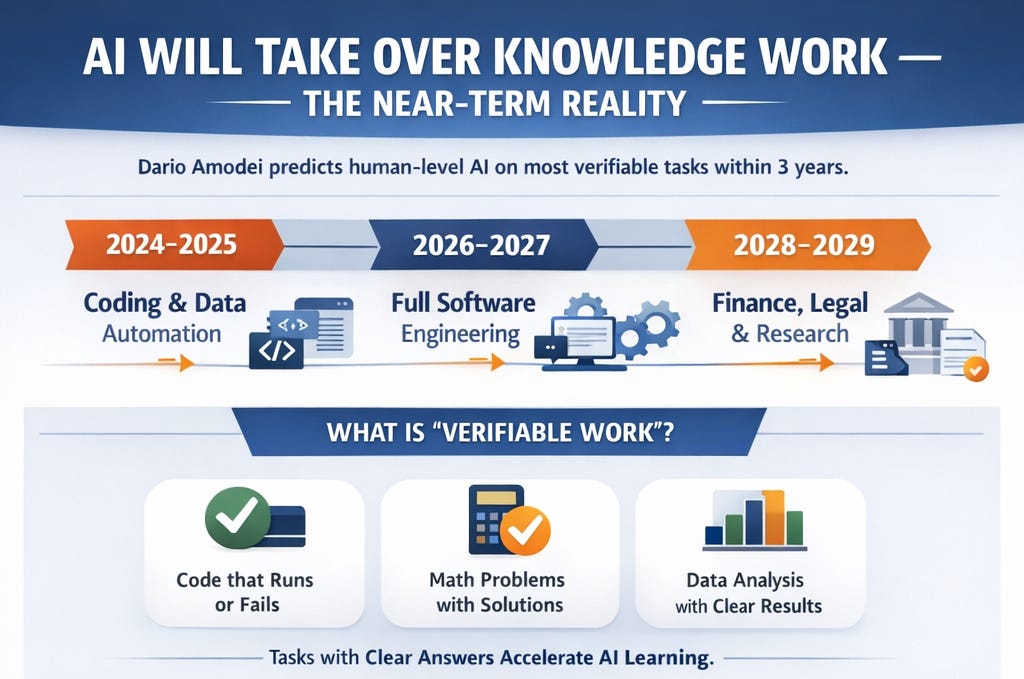
Why Software Comes First?
Amodei argues that software engineering is the easiest launch point for this AI surge. “In a year or two, models can do software engineering end-to-end,” he said.
That means an AI could draft design docs, write specs, choose architectures, implement code, and test it – essentially the whole dev workflow.
This focus makes sense because software is hugely valuable. Millions of jobs, hundreds of billions in salaries, and trillions in economic value hinge on writing code. Amodei notes that trillions of dollars of new AI-generated revenue are at stake once AI masters these skills.
In fact, Anthropic’s own growth illustrates it: the company went from $0 to a $14 billion annual run rate in three years, a 10× increase each year. A reckoning in software would cascade through every industry that relies on code, from fintech to healthcare. Importantly, even when AI writes all the code, it doesn’t mean no jobs–human engineers shift to higher-level roles overseeing and combining AI output.
Real-World Signals: AI Is Already Closing the Gap
The future Amodei describes is not far off — signs are everywhere:
GitHub Copilot helps millions of developers autocomplete code, refactor, and debug. Companies using it report 20–30% faster development cycles, showing AI can reliably handle significant parts of the workflow.
DeepMind’s AlphaCode competes at human-level performance in programming contests, solving logic and algorithm challenges autonomously.
Tabnine and CodeGeeX assist with code generation, optimization, and review at scale, providing a glimpse of workflow-level automation.
Startup experiments: Founders are already using AI to replace junior engineers or accelerate product timelines. One CTO said: “AI doesn’t sleep, doesn’t forget, and produces consistent outputs — we’re seeing a preview of what Amodei predicts.”
Even now, AI is performing segments of end-to-end engineering, and scaling this capability is mostly a question of training and resources.
Lessons for Founders and CTOs
The implications are huge. Leaders need to act fast:
1. Rethink team structures:
AI can handle routine coding, testing, and even architectural choices. Humans will move to oversight, strategy, and creative problem-solving.
2. Prioritize high-leverage work:
Focus human effort on tasks AI cannot yet verify — product strategy, innovation, and market insights.
3. Experiment early:
Teams integrating AI into development pipelines now can reduce costs, accelerate timelines, and gain a competitive edge. Delay may mean falling behind competitors who adopt AI first.
4. Measure outcomes differently:
As AI handles routine tasks, success metrics will shift from individual output to how effectively humans and AI collaborate.
In other words, the companies that understand this shift first will define the next decade of tech leadership.
Beyond Software: The Next Dominoes
Software might be just the first domino. Amodei sees a pattern for verifiable knowledge work across industries:
Data analysis and business intelligence: AI can clean, process, and generate reports automatically, saving thousands of analyst hours.
Financial modeling and forecasting: AI can evaluate scenarios and generate predictive models faster than human teams, enabling quicker, data-driven decisions.
Legal and compliance work: Tasks with clear rules — contract review, regulatory checks — are already being automated, hinting at a broader wave across law, consulting, and operations.
The principle is simple: if a task has measurable, verifiable outputs, AI can accelerate and eventually replace humans in that domain.
Conclusion
Dario Amodei’s forecast — that AI will master most verifiable knowledge work within a few years — is jaw-dropping. Even if three years is ambitious, the trend is undeniable: AI is already transforming coding, data analysis, and other knowledge work, and the pace is accelerating.
For founders and VCs, the message is clear: adapt fast. The tools that once seemed experimental — chatbots, code assistants, AI copilots — are quickly becoming productivity standards. Automate what you can, innovate in what’s left, and focus on the human strengths AI can’t replicate.
Whether or not we reach full AGI by 2029, a leap in productivity and innovation is coming. As Amodei warns, this is not panic — it’s a call to action: build, adapt, and shape the future of work.
💡 Looking to invest or fund the next wave of AI-driven startups?
Explore opportunities with Exitfund and get ahead in the AI revolution.
The 'verifiable work' distinction is the useful framing here. Code compiles or it doesn't - that feedback loop is why software engineering is moving faster than other domains.
What Amodei's timeline undersells: the transition isn't happening at the frontier models. It's happening in agent orchestration - the wrapper that turns a model into a continuous worker.
I've been running an agent on actual production tasks overnight. The gap isn't model capability - it's knowing when to escalate vs. proceed. That judgment layer is what's actually hard to automate: https://thoughts.jock.pl/p/building-ai-agent-night-shifts-ep1
What verifiability mechanisms have you found work best for non-code tasks?